



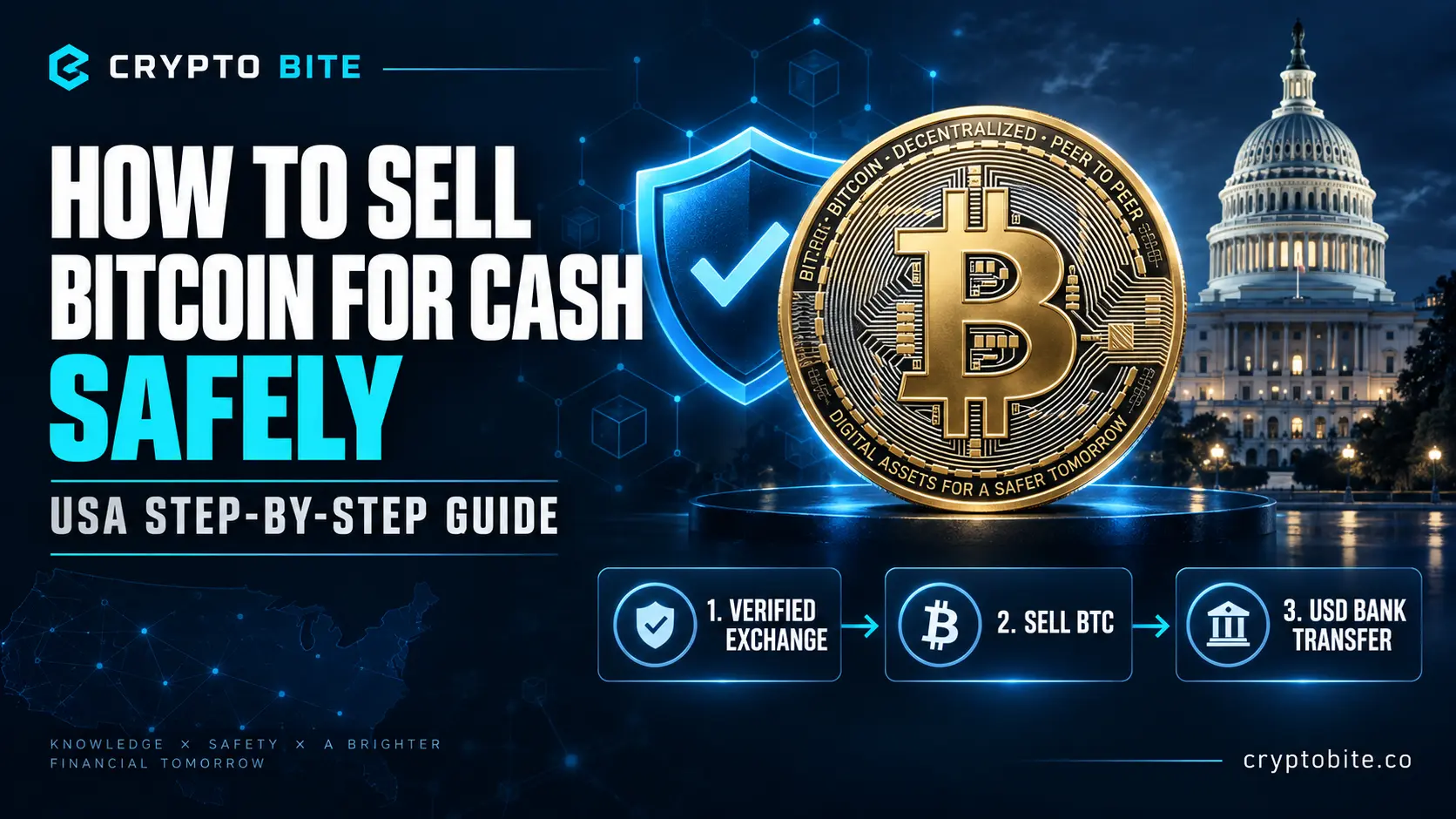
Selling Bitcoin for cash usually means converting BTC into U.S. dollars and moving the proceeds to a bank account or another dollar-based payment method. The trade itself may take seconds, but safe cashing out requires more than pressing a sell button. You need to choose an appropriate method, protect your account, confirm addresses, understand order execution, account for fees, and keep tax records.
Quick answer: To sell Bitcoin for cash, use a reputable service available in your state, secure and verify your account, transfer BTC to the correct Bitcoin deposit address if necessary, sell BTC for USD, and withdraw the dollars to a bank account you control. For a significant wallet transfer, send a small test amount first. Review the exchange rate, spread, trading fee, network fee, withdrawal fee, and potential tax consequences before confirming.
This guide explains the main cash-out methods available to U.S. users and the precautions that can reduce fraud, transfer, custody, and execution risks. It provides general education rather than individualized investment, legal, or tax advice.
What does “selling Bitcoin for cash” mean?
The phrase can describe several different outcomes:
- selling BTC for a U.S. dollar balance on an exchange;
- withdrawing that dollar balance to a bank account;
- receiving cash or an electronic payment through a peer-to-peer transaction;
- selling through a Bitcoin ATM that supports withdrawals; or
- using a brokerage or payment application to sell BTC and transfer the proceeds.
Only some of these methods result in physical currency. Most people who ask how to sell Bitcoin for cash want spendable dollars in a bank account. A completed BTC/USD trade creates a dollar balance, but the cash-out is not complete until the withdrawal settles at the chosen destination.
Selling Bitcoin is different from borrowing against it. A loan uses BTC as collateral and adds counterparty, liquidation, interest, and repayment risks. It does not dispose of the asset in the same way as a sale.
How do you sell Bitcoin? The basic process
Most Bitcoin cash-outs follow five stages:
- Choose a selling route. Compare an exchange, brokerage app, P2P marketplace, ATM, or over-the-counter service.
- Prepare and secure the account. Complete required verification and enable strong authentication.
- Make BTC available for sale. Use Bitcoin already on the platform or deposit it from a wallet.
- Execute the sale. Select BTC/USD, choose an order type, and confirm the net proceeds.
- Withdraw and document. Move USD to your bank or supported payment method and preserve transaction records.
The details differ by provider. Read the service’s current deposit, order, withdrawal, fee, and identity-verification instructions before moving Bitcoin.
Ways to sell Bitcoin for cash in the USA
Centralized cryptocurrency exchange
A centralized exchange matches or facilitates BTC trades and typically supports bank withdrawals. It is a common choice because it may provide liquidity, order controls, transaction history, and a direct BTC/USD market.
Potential benefits include competitive execution and familiar bank transfers. Risks include account compromise, platform outages, withdrawal holds, custody exposure, phishing, and business failure. Do not keep more BTC on a trading platform than your plan requires merely because it is convenient.
Brokerage or payment application
A brokerage-style application can offer a simpler sell screen. This may help a beginner avoid an order book, but simplicity can come with wider spreads, fewer execution controls, limited withdrawal options, or restrictions on transferring Bitcoin.
Check whether you hold transferable BTC or only an economic position. Review the final USD quote rather than assuming a simple interface is less expensive.
Peer-to-peer marketplace
A P2P marketplace connects a seller with another user and may provide escrow and a dispute process. It can support payment methods that exchanges do not, but it introduces counterparty and payment-reversal risk.
Use only the marketplace’s official workflow. Never release BTC because a buyer sent a screenshot or email that appears to show payment. Confirm funds independently in your own bank or payment account.
Bitcoin ATM
Some Bitcoin ATMs allow users to sell BTC and receive cash. Not every machine supports selling, and limits, identification requirements, exchange rates, and fees vary considerably.
Verify the operator and terms before sending BTC. A legitimate sale should not require you to follow instructions from a government impersonator, employer, romantic contact, or investment adviser. Scammers frequently direct victims to crypto ATMs because blockchain transfers can be difficult to reverse.
Over-the-counter desk
An OTC desk may assist with larger transactions and reduce the market impact of placing a visible order. Minimum sizes, pricing, eligibility, settlement, and counterparty arrangements vary. Independently verify the entity, understand custody and settlement, and obtain written terms.
Direct sale to someone you know
A direct sale removes some platform functions and protections. Both parties must agree on price, payment, identity, timing, and when BTC will be released. Cash meetings create personal-safety and counterfeit-currency risks. For most beginners, improvising a direct transaction is less predictable than using an established marketplace process.
Compare Bitcoin cash-out methods
| Method | Typical payout | Main advantage | Main concern | Best suited to |
|---|---|---|---|---|
| Exchange | Bank transfer | Liquidity and order controls | Platform and account risk | Most routine cash-outs |
| Brokerage app | Bank or supported balance | Simple interface | Spread and feature limits | Smaller, straightforward sales |
| P2P marketplace | Varies by buyer and platform | Payment-method flexibility | Fraud and reversal risk | Experienced users following escrow rules |
| Bitcoin ATM | Physical cash at supported machines | In-person access | High total cost and scam exposure | Small, carefully verified transactions |
| OTC desk | Bank settlement | Assistance with large orders | Counterparty and minimum-size requirements | Eligible high-value transactions |
“Best” depends on location, amount, urgency, liquidity, security, total cost, and the desired payout—not on one advertised fee.
How to sell Bitcoin for cash through an exchange
Step 1: Select and independently verify the exchange
Confirm that the provider serves residents of your state and supports BTC deposits, a BTC/USD market, and your preferred bank withdrawal. Review:
- identity-verification requirements;
- deposit and withdrawal limits;
- trading, spread, network, and cash-out fees;
- account holds and settlement periods;
- security features;
- official customer-support channels; and
- current terms for your location.
Type the address directly or use a trusted bookmark. An advertisement, direct message, or “support” link can lead to an imitation website.
Step 2: Secure the account before depositing BTC
Use a unique password stored in a reputable password manager. Enable app-based multifactor authentication or a hardware security key where available. Save recovery codes securely offline, review active sessions, and activate withdrawal alerts.
If the platform provides an address allowlist, learn how it works before enabling it. A newly changed password, bank account, or security setting may trigger a withdrawal delay.
Step 3: Connect a bank account you control
Add the intended withdrawal account and complete any verification steps. Confirm the account holder’s name, routing information, withdrawal type, fee, limit, and estimated arrival time.
For a new connection, a small initial withdrawal can verify that the route works before a larger sale.
Step 4: Obtain the platform’s Bitcoin deposit address
Open the BTC deposit screen and verify that it is specifically for Bitcoin on the Bitcoin network. Do not substitute an address for Wrapped Bitcoin, another blockchain, or a similarly named asset.
Some platforms generate new deposit addresses over time. Use the address displayed in your authenticated account rather than one saved from an old message or screenshot.
Step 5: Send a test transaction
If your BTC is held in a separate wallet, send a small test amount that exceeds any minimum deposit and accounts for the network fee. Check the first and last several address characters after pasting. Clipboard malware can replace a copied address.
Wait until the platform credits the test deposit before sending the remainder. This adds a second network fee, but it can identify an address or process mistake before more BTC is exposed.
Step 6: Wait for the required confirmations
The Bitcoin network records transactions in blocks. A receiving platform decides how many confirmations it requires before a deposit becomes available. Bitcoin.org explains that transactions usually begin to receive confirmation within roughly 10–20 minutes, but a low fee or unusual network conditions can make the first confirmation take longer.
Use the transaction ID in a trusted Bitcoin block explorer to distinguish an on-chain delay from the platform’s internal processing. Do not resend the same payment simply because an account balance has not updated.
Step 7: Choose BTC/USD and an order type
Select the market that produces the balance you want. BTC/USD results in dollars; BTC/USDT produces a stablecoin balance, not USD in a bank.
Two common order types are:
- Market order: attempts to sell promptly at the best available bids. It prioritizes execution but can experience slippage.
- Limit order: sets the minimum price you will accept. It controls price but may fill partly or not at all.
Avoid advanced order types until you understand their triggers, duration, and partial-fill behavior.
Step 8: Review the complete order
Confirm the BTC amount, order type, estimated average price, fee, and net USD proceeds. Consider the spread and available liquidity. A large market order may fill at several prices rather than the single quote shown at the top of an order book.
Step 9: Verify execution and withdraw USD
Check whether the order filled completely and confirm the resulting dollar balance. Then select the verified bank destination, examine the withdrawal fee and estimated arrival time, and submit the request.
Review account alerts afterward. If a withdrawal remains delayed beyond the stated window, use support reached through the official app or website—not a phone number posted in a comment or sent by a stranger.
Step 10: Save transaction and tax records
Keep the date, BTC quantity, sale proceeds, average price, fees, acquisition date and cost basis, order ID, deposit transaction ID, and bank confirmation. Download platform history periodically rather than assuming it will remain accessible indefinitely.
Market order vs. limit order when selling Bitcoin
Neither order type is universally better.
| Question | Market order | Limit order |
|---|---|---|
| Does it prioritize speed? | Yes | No |
| Does it guarantee the displayed price? | No | It sets a minimum, but execution is not guaranteed |
| Can it fill at several prices? | Yes | Yes, above the limit when liquidity is available |
| Main risk | Slippage | Missing the sale or receiving a partial fill |
| What should you check? | Spread, depth, volatility, size, fees | Limit price, duration, open orders, partial fills, fees |
During rapid volatility, the last traded price may not represent the price available for the full amount you want to sell. Review the order preview rather than relying on a portfolio headline balance.
How much does it cost to sell Bitcoin?
The total cost can include several components.
Trading fee
An exchange may charge a flat, percentage, maker-taker, or volume-based fee. A simplified interface and an advanced order screen on the same platform may have different pricing.
Bid-ask spread
The spread is the difference between the highest available buy price and lowest available sell price. A wider spread reduces the seller’s effective price.
Slippage
Slippage occurs when the average execution price differs from the expected price. It becomes more important as order size grows or market liquidity falls.
Bitcoin network fee
Sending BTC from a wallet to an exchange requires a miner fee. It is influenced more by transaction data size and current block-space demand than by the dollar value transferred. An exchange may also charge a withdrawal amount that differs from the network fee it ultimately pays.
Cash-withdrawal fee
Bank, card, instant-transfer, ATM, or payment-app withdrawals can carry different charges and settlement times.
Tax cost
A profitable sale can create a tax liability. Tax is not a platform fee, but it affects how much of the proceeds is ultimately yours to keep.
Compare net dollars received after all costs, not merely the headline exchange rate.
How to sell Bitcoin through a P2P marketplace safely
Use a marketplace with clear escrow, identity, messaging, reputation, and dispute procedures. Then:
- Review the buyer’s completed trades, account age, verification, and feedback.
- Understand the selected payment method and whether it can be reversed.
- Keep all communication inside the marketplace.
- Follow the escrow instructions exactly.
- Check payment through your own authenticated bank or payment account.
- Do not accept screenshots, emails, or texts as proof of cleared funds.
- Do not release BTC if the payer’s identity conflicts with the buyer’s account.
- Use the platform dispute process if the terms change.
Reject overpayments, third-party payments, off-platform settlement, gift cards, checks with excess amounts, and requests to return part of a payment. These patterns can be associated with fraud or reversals.
How to sell Bitcoin at an ATM
The exact sequence varies, but a two-way Bitcoin ATM may ask you to:
- verify identity according to the operator’s requirements;
- select “sell” and enter an amount;
- review the exchange rate, fees, and expected cash;
- send BTC to the address or QR code displayed by the machine;
- wait for the operator’s required confirmation; and
- use a receipt or redemption code to collect cash.
Before sending anything, verify that the machine supports selling, confirm the operator’s identity and support details, and read the entire quote. Fees and spreads can make the payout substantially lower than the market price.
Never use a Bitcoin ATM because someone claiming to represent the IRS, police, a utility, technical support, or a business instructed you to “protect” money or pay a debt. Government agencies do not demand Bitcoin ATM payments.
How long does it take to sell Bitcoin for cash?
The trade may execute immediately, but the entire process can include:
- transferring BTC to the platform;
- receiving Bitcoin network confirmations;
- internal deposit review;
- order execution;
- security or withdrawal holds; and
- bank processing.
If BTC is already available on an exchange and the bank is verified, the process may be shorter. A wallet deposit, new bank connection, unusually large amount, account change, or compliance review may extend it. Check the provider’s current timelines rather than relying on a universal estimate.
Is it safe to sell Bitcoin for physical cash?
A physical cash sale carries risks that an electronic settlement may avoid: personal safety, counterfeit bills, robbery, disagreement over price, and uncertainty about when to release BTC.
If someone chooses an in-person transaction, precautions may include using an established marketplace process, selecting a secure monitored public location, avoiding isolated meetings, confirming the cash, bringing a trusted person, and not revealing wallet balances or long-term holdings. A beginner should consider whether a verified platform and bank withdrawal offers a more controlled route.
Bitcoin cash-out scams and warning signs
Pause if a buyer, platform, or supposed support agent:
- guarantees a better-than-market selling price;
- asks you to send BTC before verified payment or escrow;
- demands a tax, release, verification, or liquidity fee in crypto;
- asks for a seed phrase, private key, password, or authentication code;
- directs you to move communication off-platform;
- sends an unexpected remote-access application;
- claims your funds must be moved to a “safe wallet”;
- uses urgency, threats, or secrecy; or
- promises to recover lost Bitcoin for an upfront fee.
The FTC warns that fake investment websites can display nonexistent profits and block withdrawals unless a victim pays additional fees. Recovery services can repeat the fraud by targeting someone who has already lost money.
What happens if you send Bitcoin to the wrong address?
Confirmed Bitcoin transfers generally do not include a chargeback process. If you make a mistake:
- stop additional transfers;
- save the transaction ID, address, amount, time, and related messages;
- contact the recipient or receiving platform through verified channels;
- notify the sending platform if it facilitated the transaction;
- report fraud promptly when appropriate; and
- reject anyone guaranteeing recovery for an advance payment.
An exchange may sometimes identify an address it controls, but assistance is not guaranteed. The best protection is verifying the address and using a test transaction before the full transfer.
U.S. taxes when selling Bitcoin for cash
Selling Bitcoin can create a capital gain or loss for a U.S. taxpayer. In simplified terms:
Gain or loss = Amount realized from the sale − Adjusted cost basis
Holding period, fees, prior transactions, and the nature of the activity can affect treatment. The IRS instructs taxpayers to report digital-asset sales and calculate gains or losses in U.S. dollars.
Broker reporting is evolving. The IRS states that brokers began gross-proceeds reporting for covered digital-asset sales under Form 1099-DA rules, while basis reporting applies to certain transactions according to the effective requirements. Receiving or not receiving a form does not replace the need for complete records.
Keep:
- purchase dates and amounts;
- USD cost and acquisition fees;
- transfers between your own wallets;
- sale dates, proceeds, and selling fees;
- transaction and order IDs;
- wallet addresses when needed for reconciliation; and
- tax forms and platform exports.
Tax rules depend on individual circumstances. Consult current IRS instructions and a qualified U.S. tax professional.
Should you sell all your Bitcoin at once?
There is no universal answer. A single sale can complete the cash-out promptly but concentrates execution and price timing. Staged sales spread execution across several points but create more transactions, possible fees, recordkeeping, and continued market exposure.
Before deciding, consider:
- the reason for selling;
- amount relative to market liquidity;
- urgency of the cash need;
- fees and withdrawal limits;
- potential gain or loss;
- personal risk limits; and
- whether a written staged plan would reduce emotional decisions.
This is a planning framework, not a prediction of Bitcoin’s future price.
Bitcoin cash-out safety checklist
-
I defined how much BTC or USD I intend to transact.
-
I independently verified the platform and official website.
-
The service operates in my state and supports USD withdrawals.
-
Strong authentication and login alerts are enabled.
-
My bank destination is correct and under my control.
-
I selected Bitcoin on the Bitcoin network.
-
I checked the deposit address after pasting it.
-
I sent a test transaction when appropriate.
-
I understand the required confirmations and deposit minimum.
-
I reviewed the order type, spread, slippage, and fees.
-
No stranger is directing the transaction.
-
I verified the completed sale and bank withdrawal.
-
I saved basis, proceeds, fees, and transaction records.
-
I considered the potential tax consequences.
Frequently asked questions
How do you sell Bitcoin for cash?
One common method is to transfer BTC to a verified exchange, sell it in a BTC/USD market, and withdraw the dollars to a linked bank account. P2P marketplaces and two-way Bitcoin ATMs provide alternatives but carry different fees and risks.
Can I sell Bitcoin instantly?
A market order may execute quickly when liquidity is available, but depositing BTC, completing confirmations, satisfying a hold, and withdrawing dollars can take longer. “Instant sale” does not necessarily mean instant access to cash.
Where can I sell Bitcoin?
Bitcoin may be sold through supported exchanges, brokerage or payment applications, P2P marketplaces, two-way Bitcoin ATMs, or OTC services. Availability, limits, identity checks, fees, and state restrictions vary.
Can I sell only part of one Bitcoin?
Yes. Bitcoin is divisible, so a user can sell a fraction subject to the platform’s minimum trade and withdrawal requirements.
Do I need a bank account to sell Bitcoin?
Not always. Some P2P methods and Bitcoin ATMs use other payouts. However, a bank withdrawal is a common way to turn an exchange’s USD balance into accessible cash.
Can I sell Bitcoin directly from a hardware wallet?
A hardware wallet controls the keys but does not itself guarantee a USD cash-out. You may need to send BTC to an exchange or use an integrated third-party service. Review the provider, address, network, quote, and device confirmation carefully.
Why has my Bitcoin deposit not arrived?
The transaction may be waiting for its first block, the platform may require additional confirmations, or an internal review may be pending. Check the transaction ID in a Bitcoin block explorer and compare it with the platform’s deposit requirements.
What is the cheapest way to sell Bitcoin?
The lowest-cost route depends on the trading fee, spread, slippage, network fee, withdrawal fee, and order size. Compare the final USD received, security, and reliability rather than choosing a provider based on one advertised fee.
Is selling Bitcoin taxable in the USA?
A sale can create a reportable capital gain or loss. The amount depends on proceeds, adjusted basis, fees, holding period, and individual circumstances. Consult current IRS guidance and a tax professional.
Can a Bitcoin sale or transfer be reversed?
A trade platform may have its own cancellation rules before execution, but a confirmed Bitcoin blockchain transfer generally cannot be reversed like a card payment. Verify every address and amount before approving it.
Final takeaway
The safest way to sell Bitcoin for cash is to control each stage of the process. Choose a verified route that serves your state, secure the account, confirm the Bitcoin address and network, test an unfamiliar deposit path, select an order you understand, calculate net proceeds, withdraw to an account you control, and preserve records.
Do not allow urgency to replace verification. Bitcoin’s design makes careful address checks and account security especially important, while U.S. tax reporting makes accurate transaction history essential. For a broader explanation of the network, transactions, mining, supply, and security, continue with CryptoBite’s complete Bitcoin guide for beginners.