




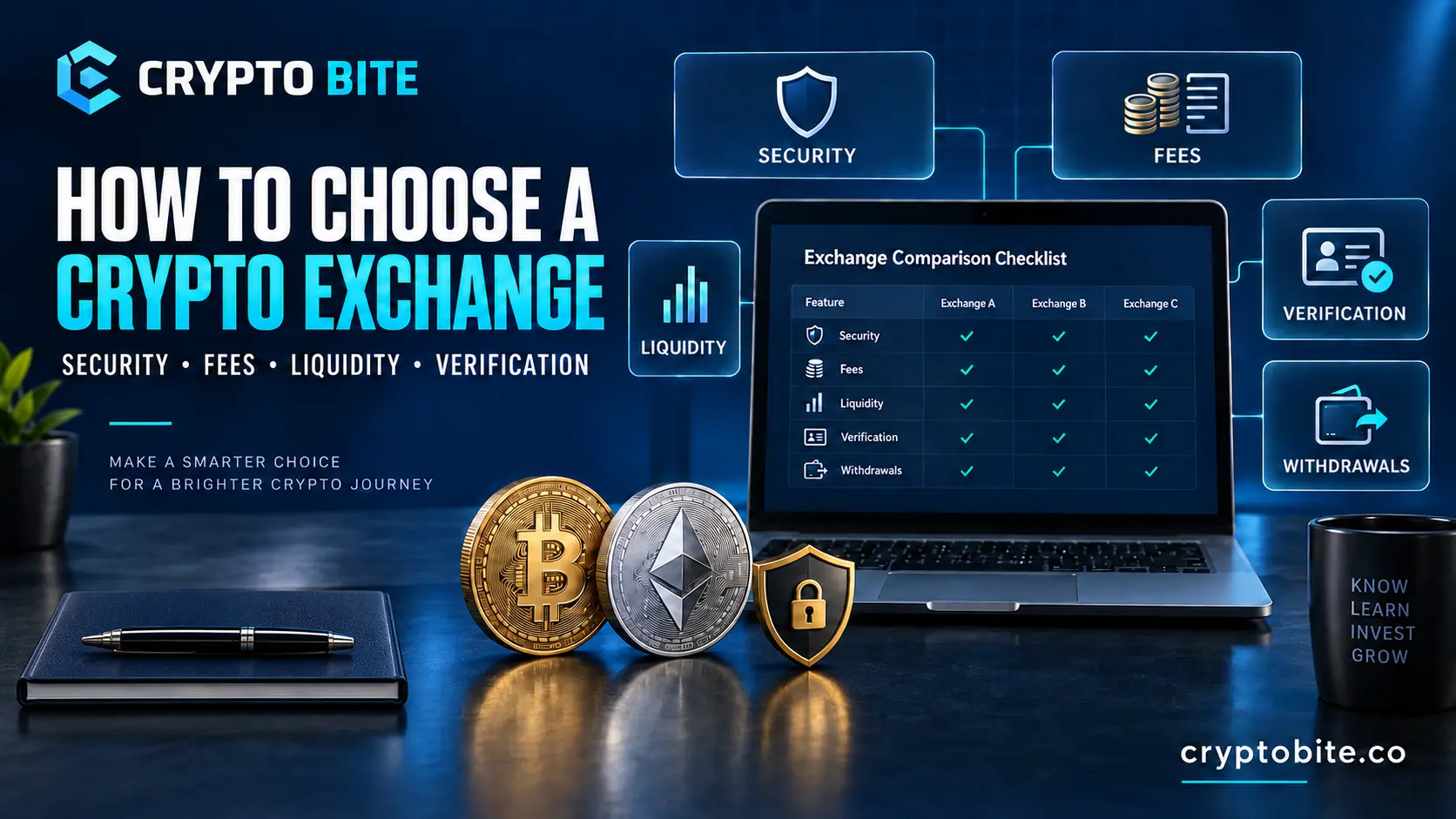
Quick answer: How should you choose a crypto exchange?
Choose a crypto exchange by confirming that it legally serves your state, investigating the operating company, understanding who controls your assets, and comparing the total cost of buying and withdrawing—not just the advertised trading fee. Then review security controls, liquidity, supported assets and networks, funding methods, withdrawal limits, verification requirements, customer support, and tax-record tools.
Before depositing a meaningful amount, create the account directly through the official website, enable strong security, make a small purchase, and test a small withdrawal to a wallet you control. No exchange is risk-free, and no single platform is best for every U.S. user.
Crypto exchange selection checklist
| Check | What to verify | Why it matters |
|---|---|---|
| U.S. and state access | Your state appears on the current availability page | Products and funding methods can vary by jurisdiction |
| Legal company identity | Legal name, address, terms, registrations, and state licenses where applicable | A familiar brand name is not enough to identify the entity holding your funds |
| Custody terms | Who controls private keys and what happens during insolvency or suspension | A displayed account balance is not the same as direct control of blockchain assets |
| Security tools | App-based or hardware-key 2FA, withdrawal allowlisting, session controls, alerts | These controls can reduce account-takeover risk |
| Total cost | Fee, spread, payment cost, withdrawal charge, network cost, subscription | A “low-fee” exchange may not be cheapest for your actual transaction |
| Liquidity | Active order book and reasonable depth for your asset and order size | Low liquidity can increase spread and slippage |
| Withdrawal access | Supported network, minimum, limits, holds, and processing rules | Buying an asset is less useful if you cannot withdraw it as intended |
| Asset and network support | Exact asset and blockchain network—not just the ticker symbol | Sending through an incompatible network can cause permanent loss |
| Verification | Required documents, expected review process, and escalation path | Verification may delay deposits, trading, or withdrawals |
| Support and records | Clear contact channels, statements, transaction history, and tax exports | Problems are easier to resolve when records and escalation procedures exist |
What is a cryptocurrency exchange?
A cryptocurrency exchange is a service that enables users to buy, sell, convert, or trade digital assets. Some exchanges connect buyers and sellers through an order book. Others provide a simple quote, execute through their own systems or liquidity partners, and show the user the final amount before confirmation.
A centralized exchange usually provides an account, identity verification, dollar funding, customer support, transaction records, and custodial storage. When assets remain on the platform, the exchange or its custodian generally controls the private keys. The customer has a contractual claim reflected in an account balance rather than direct possession of those keys.
A decentralized exchange, commonly called a DEX, uses blockchain-based smart contracts to facilitate swaps from a user-controlled wallet. A DEX may not provide a conventional account, password reset, dollar bank transfer, or customer service. The user usually pays network fees and assumes responsibility for wallet security, token verification, transaction settings, and smart-contract risk.
The word exchange can also be confusing in the United States. A crypto trading platform may use that description commercially without having the same regulatory status or investor protections as a national securities exchange. Always investigate the legal entity and the products it offers rather than relying on the label.
Editorial note: Crypto exchange fees, limits, products, asset support, verification procedures, and state availability can change at any time. Verify current details on the platform’s official website before opening or funding an account.
Risk disclosure: This article is for education only and is not financial, investment, legal, or tax advice. Cryptocurrency is volatile and may lose some or all of its value. Exchange accounts also involve custody, cybersecurity, operational, liquidity, fraud, and withdrawal risks. Registration or licensing does not guarantee that a platform is safe, solvent, or suitable for you. Crypto assets are not FDIC-insured merely because a crypto company holds them or partners with a bank.
Centralized vs. decentralized crypto exchanges
Neither structure is automatically better or safer. They distribute responsibilities and risks differently.
| Factor | Centralized exchange (CEX) | Decentralized exchange (DEX) |
|---|---|---|
| Access | Platform account; identity verification is common | Compatible self-custody wallet |
| Custody | Platform or custodian commonly controls hosted assets | User normally controls wallet keys |
| U.S. dollars | Bank, wire, card, or other methods may be available | Usually requires existing on-chain assets or a third-party on-ramp |
| Trading model | Order book, brokerage quote, or both | Smart-contract liquidity pools or on-chain order book |
| Recovery | Password and identity recovery may be available | Lost seed phrase or keys may be unrecoverable |
| Asset review | Platform chooses supported assets and networks | Broad access may include counterfeit, malicious, or illiquid tokens |
| Common costs | Trading fee, spread, payment cost, withdrawal fee | Network fee, swap fee, price impact, routing cost |
| Main risks | Custody failure, account takeover, insolvency, withdrawal suspension | Smart-contract exploits, malicious approvals, wallet compromise, network mistakes |
| Support | Help center and support channels may exist | Often no party can reverse or recover a transaction |
Who may prefer a centralized exchange?
A reputable centralized platform may be more practical for a beginner who needs dollar funding, account recovery, transaction statements, understandable trade previews, and support. It may also suit active traders who need order books, APIs, or advanced order types.
Who may prefer a decentralized exchange?
A knowledgeable self-custody user may choose a DEX for direct wallet-to-wallet swaps or access to on-chain markets. That independence comes with more personal responsibility. A DEX interface does not guarantee that a token, liquidity pool, route, or smart contract is legitimate.
Some people use both models: a centralized exchange for converting dollars and a DEX for selected on-chain activity. Using multiple tools does not remove risk; it creates more accounts, networks, records, and security responsibilities to manage.
What to look for in a crypto exchange
The best platform is the one that safely supports your actual use case. Decide what you intend to do before comparing marketing claims.
1. Availability in your state
Confirm that the platform accepts new customers in your state and that the specific product you want is available there. Spot trading, staking, rewards, bank funding, derivatives, and custody services can have different restrictions. Do not assume that a national advertisement represents identical access in every state.
2. A verifiable operating entity
The terms of service should identify the company contracting with U.S. customers. Record its legal name, address, governing terms, and support channels. Compare those details with appropriate government databases, but remember that a database entry is not a safety endorsement.
3. Clear custody and ownership terms
Read the user agreement for custody, title, asset segregation, lending, setoff rights, withdrawal suspensions, and treatment in insolvency. Avoid assuming that assets are held one-to-one or protected like money in a bank account unless the legal terms and independently verifiable disclosures support that conclusion.
4. Practical account security
Look for app-based authenticator or hardware security-key support, withdrawal allowlisting, address-lock periods, anti-phishing codes, device and session management, login alerts, and an understandable recovery process. SMS verification is better than no additional protection, but phone numbers can be vulnerable to SIM-swapping.
Security also depends on the user. Create a unique password, protect the email account attached to the exchange, secure mobile-carrier access, avoid public devices, and bookmark the real login address. Never share a password, one-time code, private key, or seed phrase with “support.”
5. Transparent total pricing
Find the fee schedule and compare it with the final order preview. Identify whether the interface uses maker/taker pricing, a simple-buy fee, a spread, or a combination. Include funding and withdrawal costs.
6. Liquidity for your asset and trade size
A large platform can still have thin liquidity in a specific trading pair. Check bid-ask spread, order-book depth, and expected execution for the amount you plan to trade. A small market order may execute cleanly while a large order moves through several price levels.
7. Supported assets and blockchain networks
Confirm the exact asset, pair, and network. For example, an exchange may support a token but not deposits or withdrawals through every network on which that token exists. Network mismatches can be irreversible.
8. Funding, holds, and withdrawal access
Compare ACH, wire, debit-card, and crypto-deposit options. Ask when funds can be traded and when purchased assets can be withdrawn. A platform may credit an ACH deposit for trading before the bank transfer fully settles, then place a temporary withdrawal hold.
9. Usability and order controls
Beginners need clear previews and records. More experienced traders may require limit orders, post-only settings, stop orders, APIs, and detailed fills. A simple interface can cost more than an advanced order book on the same platform, so compare both.
10. Customer service and incident communication
Review official contact methods, escalation paths, response expectations, and status pages. Search for patterns in complaints, but distinguish isolated frustration from repeated allegations involving frozen accounts, unexplained losses, or inaccessible withdrawals.
11. Statements and tax records
U.S. users should maintain their own records of purchases, sales, swaps, transfers, fees, rewards, and wallet movements. Check whether the exchange provides downloadable transaction history and whether exports contain the fields your tax professional or software requires. Platform reports may not capture basis from assets transferred in from another wallet.
How to check whether a crypto exchange is legitimate
To check a crypto exchange, verify its exact legal entity, state availability, registrations or licenses where applicable, domain and app publisher, custody terms, security history, withdrawal rules, and complaint patterns. Never treat a logo, influencer endorsement, app-store listing, or FinCEN registration as proof of safety.
Step 1: Verify the exact website and company
Type or bookmark the official domain. Check spelling carefully, especially when arriving through an advertisement, direct message, or search result. Fraudulent sites can copy logos, dashboards, help articles, and employee names.
The user agreement should name the company serving U.S. customers. Confirm that the company name matches the relevant registrations and app-store publisher. Be cautious if ownership is hidden, addresses conflict, or customer funds are sent to unrelated individuals or entities.
Step 2: Check FinCEN information correctly
Many U.S. crypto businesses may fall within federal money-services-business requirements. FinCEN provides an MSB Registrant Search, but FinCEN explicitly warns that registration is not a recommendation, certification, or endorsement and does not verify that the business is legitimate. Use registration as one data point, never as the final answer.
Step 3: Check state-level requirements
Depending on the business model and state, money-transmitter or virtual-currency licensing may apply. Review the exchange’s licenses page and confirm claims through the named state regulator or NMLS Consumer Access where appropriate. Rules and product availability vary, so a license in one state does not prove authorization everywhere.
Step 4: Review regulator and enforcement sources
Search the SEC’s Investor.gov site, CFTC advisories, FTC scam guidance, state regulator websites, and attorney-general announcements for warnings or actions involving the legal entity. An investigation or lawsuit requires context and is not automatically a final finding, but it belongs in a risk assessment.
Step 5: Read the legal documents
Review terms of service, privacy policy, fee schedule, custody disclosures, risk statement, dispute process, and prohibited-use rules. Look for vague or contradictory language about withdrawals, ownership, insurance, and asset use.
Step 6: Evaluate security evidence carefully
Useful evidence may include independently conducted security audits, recognized security certifications, bug-bounty programs, custody explanations, proof-of-reserves disclosures, and incident reports. None is conclusive alone. Proof of assets without reliable information about liabilities and control does not establish solvency.
Step 7: Test deposits and withdrawals
Start small. Confirm that the platform accepts your funding source, the quoted trade is understandable, and a withdrawal reaches the intended wallet on the correct network. A successful small test does not eliminate future platform risk, but it can identify practical problems before more funds are committed.
Red flags that require caution
- guaranteed profits or “risk-free” returns;
- unsolicited investment coaching through social media or messaging apps;
- pressure to deposit immediately or pay a fee to unlock withdrawals;
- a website that closely imitates a known exchange;
- support representatives asking for passwords, codes, keys, or seed phrases;
- no identifiable legal company or inconsistent addresses;
- fake regulator seals or claims that registration guarantees safety;
- prices that differ dramatically from established markets without explanation;
- deposits accepted only through unusual personal accounts or irreversible methods;
- no clear withdrawal policy or repeated complaints about inaccessible funds.
Crypto exchange fees explained
The true cost of using a crypto exchange can include a trading fee, spread, payment-processing fee, deposit charge, withdrawal fee, blockchain network fee, conversion cost, and subscription expense. Compare the amount of crypto received and the amount delivered after withdrawal—not only the headline rate.
Trading fees
An order-book platform may charge a percentage of the trade according to order type and recent trading volume. Rates often decline at higher volume tiers. A beginner should not assume that a displayed “starting at” rate applies to a small new account.
Spread
The bid-ask spread is the gap between available buy and sell prices. A brokerage-style or instant-buy interface may include a spread in the quote. During volatility or in a thin market, this cost can expand even if the listed fee stays unchanged.
Deposit and payment fees
ACH deposits may cost less than debit-card purchases, wires, payment apps, or other instant methods. “Free deposit” only describes the funding step; it does not mean the later crypto purchase is free.
Withdrawal and network fees
Moving crypto to an external wallet may involve an exchange withdrawal charge, a blockchain network fee, or a combined dynamic amount. Compare the fee, withdrawal minimum, and supported network before buying—especially for a small balance.
Subscription and account fees
Some platforms offer subscriptions or account tiers that modify trading costs or add benefits. Calculate whether your realistic usage justifies the recurring price. “Zero trading fees” may have limits and does not necessarily remove spreads or network costs.
A practical cost comparison
Use the same scenario on every shortlisted platform:
- Choose the dollar amount you realistically plan to deposit.
- Select the same funding method.
- Preview a purchase of the same asset at nearly the same time.
- Record the crypto quantity, explicit fee, and total dollar charge.
- Check the cost and minimum to withdraw that quantity on your intended network.
- Compare simple-buy pricing with the advanced trading interface if available.
Estimated total cost = funding cost + trading fee + spread or price impact + withdrawal charge + network fee + allocated subscription cost.
Maker fees vs. taker fees
A maker order adds liquidity to an order book; a taker order removes liquidity by matching an available order. Exchanges often charge different fees for these roles.
A limit order placed below the current lowest sell price, for example, may rest on the book and become a maker order. A market order normally executes against existing orders and is treated as a taker. A limit order is not automatically a maker: if its price crosses the market and fills immediately, that portion can be charged as taker activity.
Some platforms offer a post-only option designed to prevent an order from executing immediately. The order is posted as maker liquidity or canceled if it would take liquidity. Availability and behavior differ by exchange.
Do not choose an exchange solely because its maker rate is low. If you mainly use instant buys or market orders, the taker rate and execution quality matter more.
Crypto exchange deposit and withdrawal limits
Limits can depend on verification level, state, funding method, account age, transaction history, security changes, asset, blockchain network, and risk review.
Common restrictions include:
- daily, weekly, or rolling bank-deposit limits;
- separate debit-card or wire limits;
- crypto deposit minimums;
- per-transaction and daily crypto withdrawal limits;
- asset-specific withdrawal minimums;
- temporary holds after ACH funding;
- delayed withdrawals after password, device, email, or 2FA changes;
- enhanced review for unusual or large transfers.
Check both the public policy and the limit shown inside your verified account. Public maximums may not match a new user’s actual allowance. If you plan a large transaction, ask support about documentation and timing before moving funds.
Limits are not the same as liquidity. An exchange may allow a large order but lack enough market depth to execute it near the displayed price.
How exchange liquidity affects crypto trading
Liquidity describes how easily an asset can be bought or sold without causing a large price movement. A liquid market normally has active participants, a narrow bid-ask spread, and enough orders near the current price.
Liquidity should be evaluated for the exact trading pair. BTC/USD and BTC/USDT are different markets, and the same asset can have different depth across exchanges. Reported trading volume can be useful, but visible order-book depth and actual execution are more relevant to a specific order.
Low liquidity can create:
- wider spreads;
- partial fills;
- greater slippage;
- longer execution times for limit orders;
- difficulty exiting a position;
- larger price movements from relatively small trades.
For a larger order, consider a limit order, staged execution, or an exchange’s legitimate institutional or over-the-counter service. Each approach introduces tradeoffs and should be evaluated independently.
What is slippage in cryptocurrency trading?
Slippage is the difference between the expected trade price and the average price at which the trade actually executes. It can occur when the market moves or when an order consumes liquidity at multiple price levels.
Suppose an app displays Bitcoin at $60,000. A $100 market order may fill close to that level in a deep market. A much larger order in a thin market could buy all available units at $60,000 and continue filling at $60,050, $60,100, and higher. The average execution would be worse than the first displayed price.
Slippage can increase because of:
- market volatility;
- low liquidity;
- large order size relative to available depth;
- wide spreads;
- delays between quote and execution;
- decentralized exchange routing and price impact;
- maximum-slippage settings that are too permissive.
Ways to manage it include using a liquid pair, reducing order size, using limit orders when appropriate, avoiding unusually volatile periods, and reviewing the final preview. A limit order controls price but does not guarantee execution.
Crypto exchange order types explained
Available order types and definitions vary. Read the platform’s official documentation before trading.
Market order
A market order seeks immediate execution at the best available prices. It prioritizes speed, not a guaranteed price. The final average may differ from the displayed last trade in a fast or illiquid market.
Limit order
A limit order sets the maximum price a buyer will pay or the minimum price a seller will accept. It provides price control but may fill partially or not at all.
Stop order
A stop order activates after a specified trigger price is reached and may then become a market order. Once triggered, execution price can differ from the stop price.
Stop-limit order
A stop-limit order activates a limit order at the trigger. It controls the acceptable execution price but may remain unfilled if the market moves through the limit.
Post-only order
A post-only instruction attempts to ensure that the order adds liquidity instead of filling immediately. It can help a trader avoid taker treatment, but it may be canceled or rejected when it would cross the book.
Immediate-or-cancel and fill-or-kill
An immediate-or-cancel order executes the available portion immediately and cancels the rest. A fill-or-kill order generally requires the entire quantity to execute immediately or be canceled. These controls are more relevant to advanced users.
Recurring purchase
A recurring buy automatically purchases on a schedule. It is convenient for dollar-cost averaging, but users should compare its fee and spread with manual or advanced-interface orders.
Leverage, margin, futures, and options involve additional risks and may not be available to all U.S. users. Beginners should understand liquidation and contract mechanics before considering them.
How long does crypto exchange verification take?
Crypto exchange verification may take minutes for an automated approval, but it can take days or longer when documents require manual review or information does not match. There is no reliable universal timetable.
Common causes of delay include:
- blurry, cropped, expired, or unsupported identification;
- a name, birth date, or address that differs across records;
- poor lighting or failed selfie/liveness checks;
- use of a VPN or unsupported jurisdiction;
- an address document outside the allowed date range;
- high application volume;
- enhanced due diligence or source-of-funds review;
- account duplication or security concerns.
Apply through the official app or website. Provide accurate information, follow the image requirements, and use a supported document. Do not send identity documents to a social-media account or an unofficial “support agent.”
If approval is delayed, use the exchange’s official support process. Repeatedly creating accounts or submitting inconsistent details can make resolution harder.
U.S. crypto exchange verification requirements
U.S.-serving centralized exchanges commonly collect identity information to meet anti-money-laundering, sanctions, fraud-prevention, and related obligations. Requirements vary by service and account activity.
A platform may request:
- legal name and date of birth;
- residential address;
- Social Security number or part of it;
- government-issued photo identification;
- selfie or liveness verification;
- phone number and email;
- occupation, expected activity, or source of funds;
- bank-account ownership information;
- additional records for larger or unusual transactions.
Verification does not make an investment safe and does not mean the government has approved the exchange. It is an account-access and compliance process.
Review how the company stores and shares personal data. Use unique credentials, secure the associated email address, and be wary of phishing attempts that imitate verification messages.
Can you use more than one crypto exchange?
Yes. U.S. users can generally maintain accounts with more than one exchange, subject to each platform’s terms, verification, and jurisdictional rules. Multiple platforms can provide access to different assets, funding methods, liquidity, interfaces, or backup options.
Possible benefits include:
- comparing real execution costs;
- accessing a supported asset or network;
- reducing dependence on one platform’s temporary outage;
- separating long-term purchases from active trading;
- using a beginner interface and an advanced order book for different tasks.
The disadvantages are significant:
- a larger attack surface;
- more identity and bank information held by companies;
- more withdrawal policies and account-recovery procedures;
- fragmented transaction records and cost-basis tracking;
- increased risk of sending to the wrong address or network;
- temptation to trade more frequently.
Do not use multiple accounts to evade limits, geographic restrictions, sanctions controls, or platform rules. Maintain a complete transaction ledger across exchanges and wallets.
Questions to ask before joining a crypto exchange
Use these questions as a final review:
Legitimacy and availability
- What exact legal entity will hold my account or assets?
- Does the platform currently serve residents of my state?
- Which registrations or licenses does it claim, and can I verify them independently?
- Has a U.S. regulator issued a warning, enforcement action, or material notice involving the company?
- Is the official domain and app publisher easy to verify?
Custody and security
- Who controls the private keys to assets left on the platform?
- Does the agreement explain asset ownership, segregation, lending, and insolvency treatment?
- Does the exchange support authenticator-app or security-key 2FA?
- Can I create a withdrawal allowlist and review active sessions?
- What happens after an account-security change or suspected compromise?
- What does any insurance actually cover—and what does it exclude?
Costs and execution
- Does my intended interface use a fee, spread, maker/taker schedule, or combination?
- What would I receive after buying and withdrawing my normal amount?
- How liquid is the exact pair I plan to trade?
- Which order types are available, and how are they charged?
Funding and withdrawals
- Which deposit methods are available, and when can funded assets be withdrawn?
- What are my verified account’s actual limits?
- Does the exchange support my intended blockchain network?
- What are the withdrawal minimum, fee, confirmation requirements, and review process?
Support and records
- How do I reach official support and escalate an unresolved problem?
- Can I export complete transactions, fees, deposits, and withdrawals?
- Is there a public status page and a transparent incident-notification process?
- Would I still choose this platform if a promotion or referral bonus disappeared?
A safer process for opening and testing an account
- Navigate directly to the verified official domain.
- Read the U.S. terms, current fee schedule, state availability, custody disclosures, and privacy policy.
- Create a unique password with a password manager.
- Enable app-based or hardware-key 2FA before funding.
- Secure the connected email and mobile-carrier account.
- Complete verification only through official channels.
- Deposit a small amount using the method you plan to use later.
- Preview and execute a small trade, recording the displayed costs.
- Add the destination wallet carefully and verify the network.
- Send a small test withdrawal before transferring more.
- Confirm receipt on a reliable block explorer where appropriate.
- Save statements and transaction records independently.
This process cannot guarantee safety. It reduces avoidable mistakes and gives you direct evidence about the platform’s workflow before you commit more funds.
How this guide connects to our U.S. exchange comparison
Choosing criteria and choosing a specific platform are different decisions. This guide provides the evaluation framework: legitimacy, custody, security, fees, liquidity, order controls, limits, verification, and withdrawal access. Once you know which factors matter for your situation, use our comparison of the best crypto exchanges in the USA to build a shortlist, then verify each finalist against its current official disclosures. The comparison should support your research—not replace your own checks.
Frequently asked questions
What is the most important factor when choosing a crypto exchange?
The most important factor is whether the platform can safely and legally support your intended activity in your state. That requires evaluating the legal entity, custody terms, withdrawal access, security controls, and total cost together—not relying on one ranking.
What is the safest crypto exchange?
No exchange can be declared universally safest. Security depends on custody, financial condition, operational controls, account protections, legal terms, incident response, and user behavior. Compare evidence and avoid keeping more assets on a platform than your purpose requires.
What is the best crypto exchange for beginners?
Beginners should prioritize a clear interface, transparent trade previews, strong security settings, reliable dollar funding, supported withdrawals, accessible records, and responsive support. The lowest advertised trading fee is not necessarily the best beginner crypto exchange experience.
How can I tell whether a crypto exchange is legitimate?
Verify its legal company, official domain, state availability, claimed registrations or licenses, terms, custody disclosures, regulator notices, and withdrawal process. Remember that FinCEN registration is not an endorsement or proof that a business is safe.
Are cryptocurrencies on an exchange FDIC-insured?
Crypto assets are not FDIC-insured. Pass-through deposit insurance may apply to eligible U.S. dollar deposits placed at an insured bank only when specific requirements are satisfied; it does not insure cryptocurrency or protect against a crypto company’s failure.
Is a centralized or decentralized exchange better?
A centralized exchange may be more convenient for dollar funding, records, and account recovery. A decentralized exchange gives users more direct wallet control but adds smart-contract, token, network, and key-management risks. The better fit depends on the user’s knowledge and objective.
What is the difference between maker and taker fees?
A maker order adds liquidity by resting on an order book, while a taker order executes against existing liquidity. Exchanges may charge different rates. A limit order that fills immediately can be treated as a taker order.
Why is the final crypto purchase cost higher than the advertised fee?
The transaction may include a spread, payment-processing charge, price movement, or other fee. Compare the final dollar total and crypto quantity in the preview, then include the future withdrawal cost.
What is slippage in crypto?
Slippage is the difference between the expected price and the average execution price. It commonly increases with volatility, low liquidity, or an order that is large relative to available market depth.
How long does crypto exchange verification take?
Automated verification can finish in minutes, but manual review may take days or longer. Document quality, information mismatches, application volume, location, and enhanced review can affect timing.
Can I use two crypto exchanges?
Yes, if both platforms serve you and you follow their rules. Multiple accounts can improve access and flexibility but increase security exposure, recordkeeping work, and transfer-error risk.
Should I keep cryptocurrency on an exchange?
An exchange balance may be convenient for trading, but it carries third-party custody risk. Self-custody removes exchange custody but makes the user responsible for keys, backups, transactions, and wallet security. Understand both options before deciding.
Should I test a crypto withdrawal?
Yes. A small withdrawal can confirm the address, network, minimum, fee, and workflow before a larger transfer. Always verify the destination and network independently; blockchain transfers may be irreversible.
Final takeaway
Choosing a crypto exchange is a risk-and-fit decision, not a search for the biggest coin list or the lowest headline fee. Confirm that the platform serves your state, identify the legal entity, read the custody and withdrawal terms, protect the account, and calculate the real cost of your intended activity. Evaluate liquidity and order types for the specific market you will use, then test the entire process with a small amount.
A careful exchange selection cannot remove cryptocurrency risk. It can, however, help you avoid preventable costs, unsuitable platforms, weak security practices, and operational surprises.

1 Comment
Pingback: Best Crypto Exchanges in the USA: 2026 Comparison