





Bitcoin: A Complete Guide for Beginners
Bitcoin introduced a new way to transfer and store value online without requiring one bank or company to maintain the authoritative ledger. Since its launch in 2009, it has developed from an experimental peer-to-peer payment system into a globally traded digital asset, an open monetary network, and the foundation for technologies such as the Lightning Network and Ordinals.
Understanding Bitcoin requires more than watching its price. Beginners need to know how the blockchain works, what wallets actually control, why miners consume electricity, how transaction fees are determined, what a halving changes, and which legal and security responsibilities apply in the United States.
This Bitcoin guide provides a practical overview of those topics. It covers Bitcoin basics, buying and using bitcoin, mining, halvings, and major technologies built around the network. Each section also creates a natural path to a more detailed supporting article.
Bitcoin at a Glance
Bitcoin is a decentralized digital asset and payment network that records transactions on a public blockchain secured through proof of work. No central bank issues bitcoin, and no single company controls the protocol.
Key facts include:
- Bitcoin launched in January 2009 after a white paper was published under the name Satoshi Nakamoto.
- The protocol limits total issuance to approximately 21 million bitcoin.
- One bitcoin can be divided into 100 million smaller units called satoshis.
- New bitcoin enters circulation through mining rewards.
- The block subsidy is cut in half every 210,000 blocks, roughly every four years.
- Transactions are publicly recorded, but addresses do not automatically display a person’s legal name.
- Bitcoin ownership is controlled through cryptographic keys.
- Bitcoin is part of cryptocurrency, but cryptocurrency includes many other networks and assets.
Bitcoin Basics
What Is Bitcoin and How Does It Work?
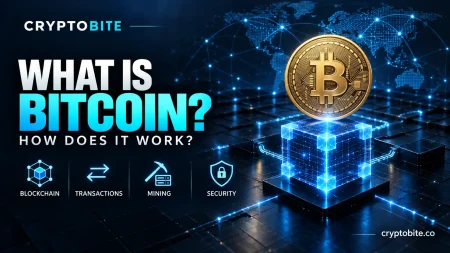
Bitcoin is both a digital asset and a peer-to-peer network for transferring that asset. It uses a public ledger called the blockchain to establish transaction history and prevent the same coins from being spent twice.
A Bitcoin wallet creates and stores the information needed to control funds. When a user sends Bitcoin, the wallet signs a transaction with a private key and broadcasts it to the network. Independent nodes check the transaction against Bitcoin’s consensus rules. Miners assemble valid transactions into blocks and compete to add the next block through proof of work.
The recipient does not receive a physical or standalone digital coin. The blockchain records spendable transaction outputs, and the recipient’s keys allow a wallet to authorize their future use.
Who Created Bitcoin?
Bitcoin was introduced by a person or group using the pseudonym Satoshi Nakamoto. The creator’s real identity has never been conclusively established.
Satoshi published Bitcoin: A Peer-to-Peer Electronic Cash System in October 2008 and released early software in 2009. Satoshi communicated with developers during Bitcoin’s early years and later withdrew from public activity.
Many people have been proposed as Satoshi, but speculation is not proof. Bitcoin does not currently depend on its creator: its open-source software can be reviewed and modified, while network participants independently decide which rules they accept.
Why Was Bitcoin Created?
Bitcoin was created to enable electronic payments between participants without requiring a trusted financial intermediary to validate every transaction.
Digital money had a fundamental problem: digital information can be copied. Traditional payment systems solve the resulting double-spending risk through central databases and intermediaries. Bitcoin proposed a peer-to-peer network that orders transactions through a proof-of-work blockchain.
The first block also included a newspaper headline about a bank bailout, which is often interpreted as commentary on the financial environment of the time. Nevertheless, the protocol’s clearest stated purpose appears in the white paper: peer-to-peer electronic cash and a technical solution to double spending.
How Many Bitcoins Are There?
Bitcoin’s protocol limits total issuance to approximately 21 million BTC. The circulating amount is lower because the final units have not yet been mined and some existing bitcoin is likely inaccessible due to lost keys.
New bitcoin is issued to miners as part of the block reward. The issuance rate decreases at each halving. Because Bitcoin Core nodes verify the supply rules, a miner cannot simply create extra valid bitcoin outside the permitted schedule.
“Circulating supply” should not be confused with “available for sale.” Some coins may be held for years, locked in scripts, or permanently lost. The exact amount that remains economically accessible cannot be known with certainty.
What Gives Bitcoin Value?
Bitcoin’s market value comes from what buyers and sellers are willing to exchange for it, influenced by scarcity, network utility, security, liquidity, adoption, and expectations. It is not backed by a government promise or a claim on corporate earnings.
Supporters value properties such as its predictable issuance, portability, divisibility, resistance to unilateral rule changes, and ability to be held without a bank. Critics emphasize volatility, energy use, regulatory uncertainty, custody risks, and the possibility that demand may decline.
Scarcity alone does not guarantee value. Bitcoin remains valuable only while people choose to use, hold, or accept it. Its price can move sharply when demand, liquidity, regulation, macroeconomic conditions, or market sentiment changes.
Is Bitcoin Legal in the United States?
Buying, owning, selling, and using Bitcoin is generally legal in the United States, but particular activities, services, and transactions are regulated. Federal and state requirements may apply differently to individual users, exchanges, brokers, miners, and money transmitters.
The IRS treats digital assets such as bitcoin as property for federal tax purposes. Selling bitcoin, exchanging it for another asset, spending it, receiving it as income, or earning mining rewards can have tax consequences. Certain businesses transmitting convertible virtual currency may have registration, recordkeeping, reporting, and anti-money-laundering obligations.
Rules also vary by state and can change. “Bitcoin is legal” should never be interpreted as meaning that every platform, offer, tokenized product, mining arrangement, or promotional claim is approved by a regulator.
Can Bitcoin Be Traced?
Yes. Bitcoin transactions are recorded on a public blockchain and can be followed from one address to another. Blockchain analytics can connect patterns of activity, while regulated platforms may associate addresses with verified customers.
Tracing funds is not identical to identifying a person. An address contains no built-in legal name, and users can create multiple addresses. However, exchange records, reused addresses, transaction patterns, public posts, merchant data, and other information can reveal connections.
Users should assume Bitcoin activity may become identifiable. Attempting to hide illegal proceeds can create serious legal consequences, and privacy tools may carry additional operational or compliance risks.
Is Bitcoin Anonymous?
Bitcoin is better described as pseudonymous than anonymous. Transactions are public, while identities are represented by addresses and cryptographic keys rather than names.
Privacy can be reduced when addresses are reused, funds pass through identity-verified services, or several transaction inputs reveal common ownership. Even information shared outside the blockchain can connect a person with an address.
Using a new receiving address, protecting wallet metadata, and understanding how transaction inputs and change work may improve privacy, but they do not guarantee anonymity.
What Happens When All Bitcoins Are Mined?
After the final bitcoin is issued—expected around the year 2140—miners will no longer receive a block subsidy and will depend on transaction fees for revenue.
Mining itself will not necessarily stop. Miners will still assemble transactions, perform proof of work, and compete to add blocks as long as expected fees justify their costs. The transition is gradual because the subsidy decreases over many halvings rather than ending suddenly.
No one can know today whether future fees will provide an adequate security budget. Transaction demand, Bitcoin’s price, mining efficiency, layer-two usage, and protocol development will all influence the outcome.
Bitcoin vs. Cryptocurrency: What Is the Difference?
Bitcoin is one cryptocurrency; cryptocurrency is the broader category of blockchain-based digital assets.
| Bitcoin | Cryptocurrency category |
|---|---|
| One specific network and asset | Includes Bitcoin and many other assets |
| Launched in 2009 | Includes later networks with different purposes |
| Approximate 21-million supply cap | Supply policies vary widely |
| Uses proof of work | May use proof of work, proof of stake, or other systems |
| Focuses primarily on value transfer and monetary properties | May support payments, smart contracts, games, governance, or other functions |
Your general cryptocurrency pillar should explain the entire asset class. This Bitcoin pillar should go deeper into the Bitcoin network without attempting to rank for every broad cryptocurrency query.
Buying and Using Bitcoin
How to Buy Bitcoin in the USA
Most U.S. beginners buy bitcoin through a reputable exchange or brokerage that supports their state and accepts dollar deposits.
A cautious process is:
- Decide why you are buying and how much you can afford to lose.
- Compare platforms by availability, security, total fees, spreads, withdrawal policies, and customer support.
- Create an account using a unique password and strong multifactor authentication.
- Complete required identity verification.
- Deposit dollars using an available payment method.
- Review the quoted price and all charges.
- Buy a small amount first.
- Save records showing the date, quantity, dollar value, and fees.
Do not select a platform because an unsolicited caller, influencer, or online contact told you to use it. Verify the official website independently and confirm that withdrawals function before committing significant funds.
How to Sell Bitcoin for Cash
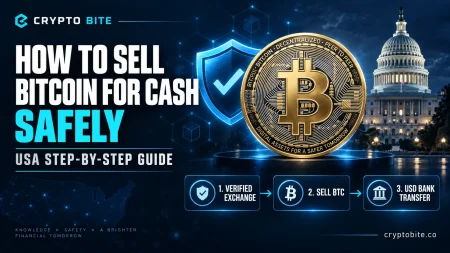
Bitcoin can usually be converted to dollars by depositing it at a compatible exchange, selling it, and withdrawing the cash to a linked bank account.
Confirm the receiving address and network before transferring bitcoin to an exchange. Review whether a market order or limit order is appropriate, and calculate the spread and bitcoin trading fee. After the sale settles, withdraw only to an account you control.
Bitcoin ATMs and peer-to-peer services may offer alternatives, but their fees, availability, identity requirements, and fraud risks vary. Selling bitcoin can create a taxable gain or loss, so retain the cost basis and transaction details.
How to Send Bitcoin to Another Wallet
To send bitcoin, enter or scan the recipient’s Bitcoin address, choose an amount and fee, verify the details, and authorize the transaction with your wallet.
Check several characters at the beginning and end of the address because malware can replace clipboard contents. Confirm that the destination supports the Bitcoin network rather than a similarly named token on another chain.
For a meaningful amount, send a small test transaction and wait for receipt. A confirmed Bitcoin transaction normally cannot be reversed by a bank or administrator.
How to Receive Bitcoin Payments
To receive bitcoin, generate a receiving address or QR code in a Bitcoin wallet and provide it to the payer. The wallet will display the transaction after it is broadcast and update its status as confirmations accumulate.
For a business, the invoice should specify the amount, exchange-rate method, expiration time, required confirmations, refund policy, and whether the payment is on-chain or through Lightning. Avoid reusing addresses when the wallet can generate a new one.
Receiving bitcoin for products or services can create income and recordkeeping obligations. Businesses should keep the dollar value at the time of receipt and consult qualified accounting and tax professionals.
How to Buy Bitcoin Without High Fees
To reduce the cost of buying bitcoin, compare the complete transaction cost, use lower-cost funding methods, and avoid unnecessary conversions or withdrawals.
Look beyond the advertised trading fee. The final cost can include a card fee, deposit charge, trading fee, price spread, and withdrawal fee. An exchange’s advanced trading interface may offer lower fees than a simplified instant-purchase screen, although it can be more complex.
Bank transfers are often less expensive than credit or debit cards, but settlement time and limits differ. Never sacrifice platform security or regulatory suitability solely to save a small fee.
Can You Buy a Fraction of a Bitcoin?
Yes. One bitcoin is divisible into 100 million satoshis, so a buyer does not need enough money to purchase a whole bitcoin.
A platform may set its own minimum order, but that limit is unrelated to Bitcoin’s technical divisibility. For example, buying $25 worth means acquiring a fraction based on the market price and fees at that moment.
Fractional ownership does not reduce percentage-based market risk. If bitcoin’s price falls by 20%, a small fractional position also loses roughly 20% before fees.
Where Can You Spend Bitcoin?
Bitcoin can be spent with merchants, nonprofits, service providers, and individuals that accept it directly or through a payment processor. Availability changes, and some services convert the payment to dollars for the merchant.
Before paying, confirm whether the recipient accepts an on-chain transaction or Lightning payment, how the exchange rate is calculated, and whether refunds will be issued in bitcoin or dollars. Spending appreciated bitcoin may be a taxable disposition in the United States.
Gift cards or payment intermediaries can expand where bitcoin is usable, but they add counterparty risk, fees, and separate terms.
How Long Does a Bitcoin Transaction Take?
Bitcoin targets an average block interval of approximately ten minutes, but an individual transaction may confirm sooner or much later. Blocks arrive probabilistically, network demand changes, and miners usually prioritize transactions by fee rate.
A recipient may accept one confirmation for a routine payment or require several for a larger or higher-risk transaction. An exchange can also delay crediting a deposit after the blockchain confirms it because of internal reviews.
Use the transaction ID in a reputable Bitcoin block explorer to distinguish between a wallet-display delay, an unconfirmed transaction, and an exchange-processing delay.
How Much Does It Cost to Send Bitcoin?
A Bitcoin transaction fee depends mainly on transaction data size and current competition for block space—not directly on the dollar amount being sent.
Wallets commonly estimate a fee rate in satoshis per virtual byte. A transaction using many inputs can occupy more block space and cost more than a simple transaction, even if it sends less value. Fees can rise when many users want quick confirmation.
Choose a wallet that shows fee estimates and supports appropriate fee controls. Extremely low fees may cause long delays, while automatically selecting the fastest option can be unnecessarily expensive.
Bitcoin Mining
What Is Bitcoin Mining?
Bitcoin mining is the competitive process used to add valid blocks to the blockchain and secure the network through proof of work.
Miners collect valid transactions, construct candidate blocks, and repeatedly hash block-header data. A successful miner finds a hash below the network’s current target and broadcasts the block. Nodes independently verify the block before accepting it.
The miner can receive a block reward consisting of the block subsidy plus transaction fees. Mining does not involve solving useful general-purpose equations or discovering existing hidden coins; it performs measurable computational work under Bitcoin’s consensus rules.
How Does Bitcoin Mining Work?
Mining works by varying block data and computing enormous numbers of SHA-256 hashes until a miner finds a result that meets the difficulty target.
The process is probabilistic. A miner’s chance of finding a block is approximately proportional to its share of total network hash rate. More computing power increases the number of attempts but never guarantees when a particular miner will succeed.
After a valid block is broadcast, full nodes verify its proof of work, transactions, subsidy, size, and other consensus requirements. Invalid blocks are rejected even if producing them consumed substantial electricity.
Is Bitcoin Mining Profitable?
Bitcoin mining can be profitable, but profitability depends on revenue, operating costs, equipment performance, and network competition. It is never guaranteed.
Important variables include:
- Bitcoin market price
- Block subsidy and fee revenue
- Miner hash rate and efficiency
- Network difficulty
- Electricity price
- Cooling and facility expenses
- Pool fees
- Downtime and maintenance
- Hardware purchase price and depreciation
- Taxes and regulatory costs
Online calculators provide estimates, not promises. Difficulty, fees, and price can change before hardware is delivered or paid off. Residential miners often face higher electricity prices and less efficient cooling than industrial operators.
How Much Electricity Does Bitcoin Mining Use?
Bitcoin mining uses substantial electricity, but no meter directly records the entire global network’s consumption. Researchers estimate it using hash rate, hardware efficiency, and economic assumptions.
The Cambridge Bitcoin Electricity Consumption Index publishes changing estimates and ranges rather than one permanent figure. Energy use varies with mining hardware, Bitcoin’s price, fees, electricity costs, and total competition.
Electricity consumption is not identical to carbon emissions. Environmental impact depends on energy sources, location, grid conditions, equipment life cycles, and whether mining changes generation or uses otherwise curtailed energy. Claims should state their date and methodology rather than presenting a changing estimate as timeless fact.
What Equipment Is Needed to Mine Bitcoin?
Competitive Bitcoin mining generally requires specialized ASIC hardware, adequate electrical capacity, networking, cooling, and monitoring systems.
ASICs are designed to perform Bitcoin’s SHA-256 hashing far more efficiently than ordinary CPUs or GPUs. A mining setup may also require:
- A compatible power supply
- Safe circuits and electrical infrastructure
- Wired internet connectivity
- Ventilation or immersion cooling
- Noise and heat management
- Pool software and payout configuration
- Security and remote monitoring
Mining devices can be loud, hot, and power-intensive. A qualified electrician and compliance with local building, fire, lease, zoning, and utility requirements may be necessary.
What Is Bitcoin Mining Difficulty?
Mining difficulty is the protocol-controlled measure that determines how difficult it is to find a block that satisfies Bitcoin’s proof-of-work target.
The network adjusts the target every 2,016 blocks, aiming to keep average block production near ten minutes even as total hash rate changes. If blocks were found too quickly during the previous period, difficulty generally rises; if too slowly, it generally falls.
Higher difficulty reduces the expected bitcoin earned per unit of hash rate, all else equal. It also indicates that more computational work is required to alter the chain.
What Is a Bitcoin Mining Pool?
A mining pool combines the hash rate of many miners and distributes rewards according to a defined payout method.
Solo mining can produce a large but highly unpredictable payout. Pool participation generally creates smaller, more frequent payments. The pool may charge a fee and use methods such as pay-per-share, full-pay-per-share, or pay-per-last-N-shares.
Miners should evaluate payout thresholds, fee calculations, server reliability, transparency, security, geographic connectivity, and the pool’s share of network hash rate.
Solo Mining vs. Pool Mining
| Solo mining | Pool mining |
|---|---|
| Miner keeps an eligible block reward | Rewards are shared under pool rules |
| Highly variable income | Smoother expected payouts |
| No pool fee | Pool usually charges a fee |
| Requires operating infrastructure independently | Relies partly on pool infrastructure |
| Small miners may wait extremely long for a block | Better suited to predictable cash-flow estimates |
Pool mining is generally more practical for small operators, while solo mining resembles a high-variance lottery. Joining a pool does not improve the underlying expected output before fees; it mainly changes payout variance.
Bitcoin Mining Risks and Costs
Mining risks include price volatility, increasing difficulty, equipment failure, high electricity expense, regulatory changes, and hardware obsolescence.
Additional costs can include shipping, import duties, wiring, transformers, cooling, insurance, rent, security, staff, repair parts, pool fees, taxes, and disposal. A machine may become unprofitable even while functioning correctly.
Mining offers, cloud-mining contracts, and hosted facilities can also involve fraud or counterparty risk. Verify ownership, contract terms, withdrawal history, utility arrangements, insurance, and equipment access before sending funds.
Is Bitcoin Mining Legal in the USA?
Bitcoin mining is generally legal in the United States, but local and state rules, utility policies, environmental requirements, zoning, taxes, and sanctions can affect an operation.
Homeowners may face lease, homeowners-association, noise, electrical, or fire-safety restrictions. Commercial operators may require permits, utility agreements, environmental review, and business registrations.
Mining rewards can create taxable income, and later disposal may create a gain or loss. Regulations differ by jurisdiction, so miners should verify current requirements with local authorities, utilities, accountants, and attorneys.
Bitcoin Halving
What Is Bitcoin Halving?
Bitcoin halving is the scheduled reduction of the block subsidy by 50% every 210,000 blocks, or approximately every four years.
The subsidy began at 50 BTC per block. It later declined to 25, 12.5, 6.25, and—after the 2024 halving—3.125 BTC per block. Transaction fees are separate and are not cut in half by this rule.
The event is based on block height, not a fixed calendar date. Because block timing varies, future halving dates are estimates.
Why Does Bitcoin Halving Happen?
Halving enforces Bitcoin’s predetermined issuance schedule and gradually reduces the creation of new bitcoin until the supply approaches 21 million.
The rule creates a declining, predictable issuance rate without requiring a central bank to decide when supply should change. Nodes enforce the permitted subsidy for each block height and reject a block that claims more than the rules allow.
Halving does not make existing coins twice as valuable and does not directly reduce a holder’s balance. It changes the new subsidy miners can claim.
Bitcoin Halving History
| Halving | Approximate date | Block subsidy after event |
|---|---|---|
| First | November 2012 | 25 BTC |
| Second | July 2016 | 12.5 BTC |
| Third | May 2020 | 6.25 BTC |
| Fourth | April 2024 | 3.125 BTC |
The next halving is expected around 2028, but the exact date will depend on block production. This table should be reviewed whenever the article is updated.
How Does Bitcoin Halving Affect Miners?
A halving immediately reduces the block subsidy earned for a successful block, which can pressure miners whose costs remain unchanged.
Miners may respond by upgrading equipment, negotiating lower energy costs, relocating, shutting down inefficient machines, or relying more heavily on fee revenue. If unprofitable hash rate leaves, block production can temporarily slow until the next difficulty adjustment.
The effect differs between operators. Efficient miners with low costs may remain profitable while highly leveraged or inefficient competitors struggle.
Does Bitcoin Halving Affect Its Price?
A halving reduces new supply issuance, but it does not guarantee that Bitcoin’s price will rise.
Historical halvings have been followed by major market cycles, yet timing alone does not prove causation. Markets can anticipate known events, and price is also influenced by demand, liquidity, interest rates, regulation, leverage, investor behavior, and global economic conditions.
Claims that a halving makes a certain price inevitable are speculation. A responsible guide should explain the supply change without predicting returns.
What Happens After a Bitcoin Halving?
After a halving, Bitcoin continues operating normally with a smaller block subsidy. Wallet balances, transaction rules, addresses, and the target block interval do not reset.
Attention often shifts to mining economics. Hash rate may rise, remain stable, or fall depending on price, fees, efficiency, and energy costs. Difficulty eventually adjusts to actual block production.
The market response can unfold over months and cannot be separated cleanly from other economic events.
Bitcoin Supply Schedule Explained
Bitcoin’s supply schedule releases fewer new coins over time through repeated halvings until issuance effectively ends near 21 million BTC.
The subsidy follows a descending sequence: 50, 25, 12.5, 6.25, 3.125 BTC, and so forth. Because each period creates half as much as the previous one, supply approaches the limit gradually.
The schedule is enforced in software by independently operating nodes. Changing it would require participants to adopt incompatible rules, and nodes retaining the existing limit would reject blocks that violated it.
Bitcoin Technology
What Is the Bitcoin Blockchain?
The Bitcoin blockchain is the ordered public record of valid blocks and transactions recognized by nodes under Bitcoin’s consensus rules.
Each block references the previous block, creating a chronological chain. Rewriting an older transaction would require rebuilding proof of work for that block and subsequent blocks while competing with the continuing network.
The blockchain does not store account balances in the same way as a bank database. Bitcoin uses unspent transaction outputs, or UTXOs. A wallet calculates spendable funds by identifying outputs its keys can authorize.
What Is the Bitcoin Lightning Network?
The Lightning Network is a payment-channel system designed to support fast, low-value Bitcoin payments without recording every individual payment directly on the base blockchain.
Participants open channels using Bitcoin transactions and can update balances off-chain. Payments may travel through a route of connected channels. The final channel state can later be settled on the blockchain.
Lightning can improve speed and reduce on-chain footprint, but it introduces liquidity, routing, availability, backup, and implementation considerations. Custodial Lightning services add counterparty risk, while self-custody requires more responsibility.
What Are Bitcoin Ordinals?
Ordinal theory assigns serial identities to individual satoshis, while inscriptions attach content to satoshis to create Bitcoin-native digital artifacts.
Ordinals do not create a new base-chain coin and do not require Bitcoin’s consensus rules to recognize collectible value. Their ownership and transfer use Bitcoin transactions, while the indexing convention allows compatible software to track particular satoshis.
Inscriptions have increased demand for block space and generated debate about fees, data storage, use cases, and the intended purpose of Bitcoin.
What Is a Bitcoin Node?
A Bitcoin node is software that connects to the peer-to-peer network and participates in relaying or validating transactions and blocks.
A full node independently checks blocks against consensus rules, including proof of work, transaction validity, and the issuance limit. It does not need to trust a miner’s claim that a block is valid.
Running a node improves independent verification but requires storage, bandwidth, maintenance, and secure software practices. A node is not necessarily a miner; mining constructs candidate blocks, while full nodes verify them.
What Is Bitcoin Hash Rate?
Bitcoin hash rate estimates how many SHA-256 mining calculations the network performs per second. It is commonly expressed in hashes, terahashes, petahashes, or exahashes per second.
Hash rate cannot be observed directly as a single meter reading. It is estimated from block production and mining difficulty, so short-term values fluctuate.
Higher hash rate generally means an attacker would need more computing power to compete with honest mining, but hash rate alone does not measure geographic decentralization, pool control, hardware ownership, or energy sources.
What Is Bitcoin Proof of Work?
Proof of work is the mechanism that requires miners to expend computational effort when proposing blocks, allowing nodes to compare competing transaction histories using accumulated work.
Miners repeatedly hash candidate block headers. Finding a valid result is difficult, but verifying it is easy. This asymmetry makes creating an alternative history expensive while allowing ordinary nodes to check the work.
Proof of work is central to Bitcoin’s security model and electricity consumption. It should not be confused with transaction validation: miners propose blocks, but full nodes still reject blocks that violate consensus rules.
What Is Wrapped Bitcoin?
Wrapped Bitcoin is a token on another blockchain designed to represent bitcoin held or controlled through a separate custody or protocol arrangement. It is not native BTC on the Bitcoin blockchain.
Wrapped assets can make bitcoin-denominated value usable in other blockchain applications, but they introduce additional risks. These may include custodian failure, smart-contract bugs, bridge exploits, governance changes, loss of backing, or redemption restrictions.
Users should examine who controls the underlying bitcoin, how reserves are verified, how redemption works, and which legal entity or protocol bears responsibility.
What Are Bitcoin Layer 2 Networks?
Bitcoin layer-two systems process or coordinate activity beyond the base blockchain while using Bitcoin for settlement, security, or asset movement to varying degrees.
The Lightning Network is the best-known example. Other designs include sidechains, rollup-like systems, federated networks, and protocols that use Bitcoin as a settlement layer.
“Layer 2” is used loosely, and projects have different trust assumptions. Evaluate custody, bridges, validator control, withdrawal rules, fraud proofs, data availability, upgrade authority, and the extent to which Bitcoin actually secures the system.
Essential Bitcoin Safety Practices
Bitcoin’s protocol can validate transactions without protecting users from every mistake. Beginners should:
- Use unique passwords and strong multifactor authentication.
- Verify exchange and wallet websites independently.
- Never reveal a seed phrase or private key.
- Treat guaranteed returns and urgent requests as scams.
- Verify addresses on the signing device where possible.
- Send a small test before a large transfer.
- Keep wallet software and devices updated.
- Understand backups before moving to self-custody.
- Compare on-chain and Lightning invoices carefully.
- Maintain purchase, sale, fee, payment, and mining records.
- Avoid investing money required for essential expenses.
Custodial platforms offer convenience but expose users to platform failure, account restrictions, and insolvency. Self-custody removes some counterparty exposure but makes the user responsible for key security and recovery. Neither approach is risk-free.
Frequently Asked Questions
Is Bitcoin safe for beginners?
Bitcoin can be used safely with careful security practices, but its price, custody, scams, irreversible transfers, and technical complexity create substantial risks. Beginners should learn first, start small, and never risk essential funds.
Do I need to buy one whole bitcoin?
No. Bitcoin is divisible into 100 million satoshis, and most platforms allow fractional purchases subject to minimum-order policies.
Is Bitcoin controlled by a company?
No single company controls Bitcoin. Developers publish software, miners propose blocks, businesses provide services, and nodes independently enforce the rules they accept.
Can the Bitcoin supply exceed 21 million?
Bitcoin Core nodes enforce the issuance schedule and reject blocks that create more than permitted. Changing the cap would require participants to adopt different rules; nodes retaining the present rules would reject the change.
Are Bitcoin payments reversible?
Confirmed Bitcoin transactions are generally not reversible by an administrator. A recipient can voluntarily return funds, and a custodial service may sometimes stop an internal withdrawal before broadcast.
Is buying bitcoin taxable?
Purchasing bitcoin with U.S. dollars and simply holding it generally differs from selling, exchanging, spending, or earning it. Tax consequences depend on the activity and circumstances. Keep records and consult current IRS guidance or a tax professional.
Does Bitcoin guarantee protection from inflation?
No. Bitcoin has a predictable issuance cap, but its purchasing power is volatile and depends on market demand. A supply limit does not guarantee short-term or long-term price performance.
Will Bitcoin mining stop after all coins are issued?
Mining is expected to continue because miners can earn transaction fees even after the block subsidy ends. Whether future fees provide sufficient incentive will depend on conditions that cannot be known today.
Is the Lightning Network the same as Bitcoin?
Lightning is a payment network built around Bitcoin channels. It is not the base blockchain, and its transactions, liquidity, custody, and operational risks differ from ordinary on-chain Bitcoin transactions.
Is wrapped bitcoin the same as bitcoin?
No. Wrapped bitcoin is a representation on another blockchain and depends on additional custody, bridge, smart-contract, or protocol arrangements. Native BTC exists on the Bitcoin network.
Final Thoughts
Bitcoin is easier to understand when it is separated into layers. At the base is a public transaction ledger secured by proof of work and independently checked by nodes. Wallets use keys to authorize spending. Miners order transactions into blocks and earn a declining subsidy plus fees. Halvings control new issuance, while technologies such as Lightning and Ordinals extend how people use the network.
None of those features removes financial or operational risk. Bitcoin can fall sharply in price, keys can be lost, platforms can fail, miners can become unprofitable, and incorrect transactions can be permanent. The best starting point is therefore not a price prediction. It is a working understanding of the system and disciplined security habits


3 Comments
Pingback: What Is Bitcoin and How Does It Work? Beginner’s Guide
Pingback: How to Buy Bitcoin in the USA Safely
Pingback: How to Sell Bitcoin for Cash Safely: USA Guide